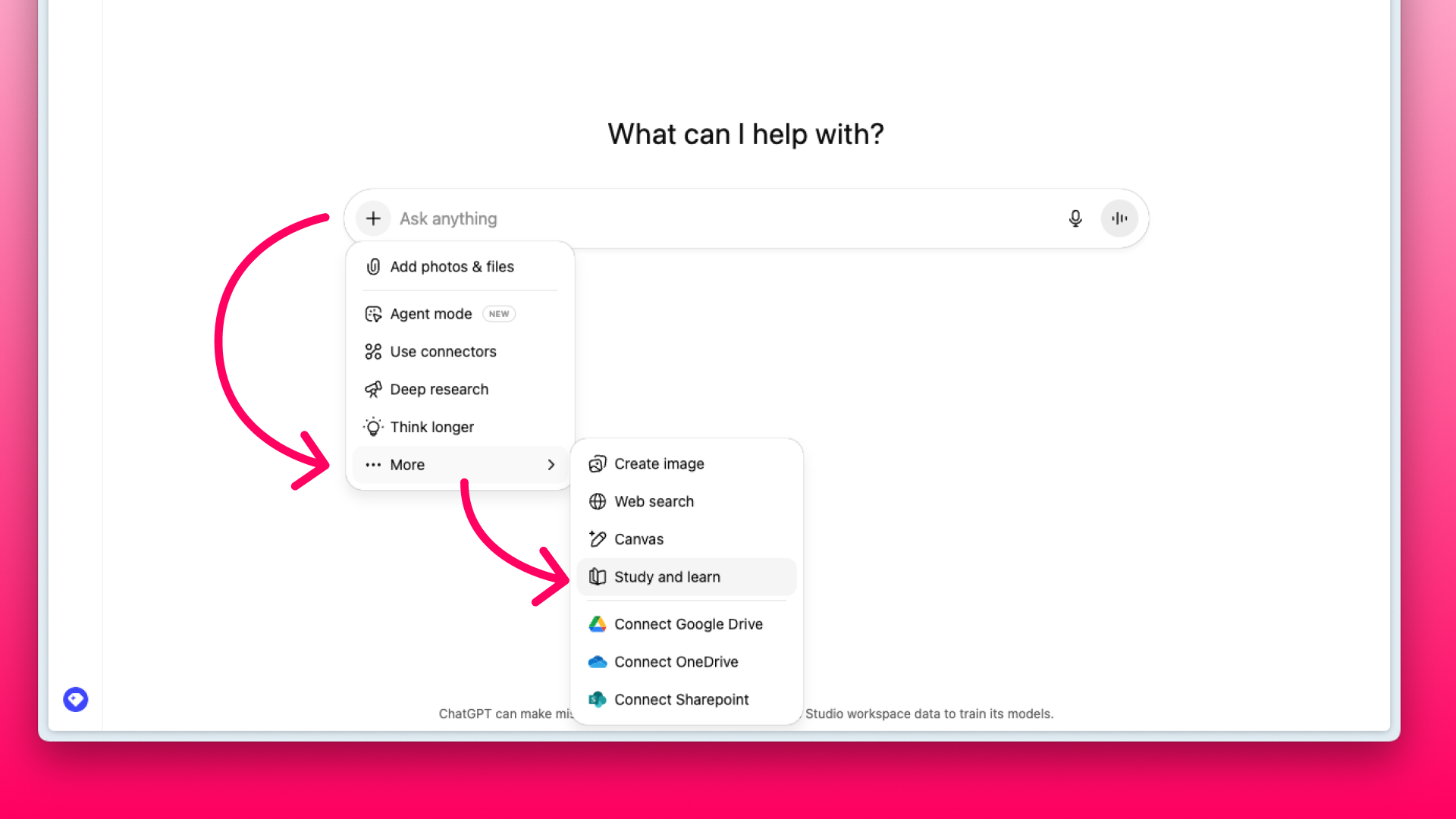
I have a question for you about the interface above.
How likely are millions of students to find GPT’s “Study and learn” mode?
I’ve even made a handy survey for you below!


Even if you’re not in the mood of filling out my survey, I do think it’s a good exercise to pause and reflect on your “Why?” before continuing to read!
My Reflection
If you’re a designer, I bet that your answer is:
“Design the interface so that it’s easier to find. We need to reduce the friction towards good behaviour.”
To which I would say you’re half right! We SHOULD reduce the friction to good behaviour! But the friction is not ChatGPT’s design.
It’s the misaligned incentives in academia. So long as we keep grading and assessing students as we currently are, education will be a game of simple metrics. Meaning, you can expect students to prioritize behaviours that might reduce learning (unintentionally) in favour of improving their grades.
This is not to say that technologies like AI can’t bring in some improvements to education. Quite the contrary, technology in general COULD play a part in facilitating the outcomes we want from teaching and learning, and I’m actively exploring ideas like this to increase social interactions in class.
But my prototype is not a revolution. It’s barely a minor step. And I’m actually quite happy with that. Multiple players need to make a lot of minor steps to make change within massive systems like education.
The alternative of turning to companies and hoping their teams fix things is not of interest to me. I don’t think offloading the responsibility of selecting learning modes, and choosing to ignore grades in favour of more cognitively rewarding learning methods should fall on the students.
While waiting on policy to change is likely to take much longer than I’d like, I’m still surprised and the reactions from academic institutions. From simple reactions to either completely ban AI or adopt it blindly, to simply doing nothing while taking years to revise curriculum.
AI didn’t break education. AI didn’t make students cheat. It’s highlighting the fact that we should have been making changes decades ago. So at the very least, can AI be the incentive to governments and educators to rethink foundations that cannot be solved with virtual tutors that are hidden behind two drop-down? Please?